
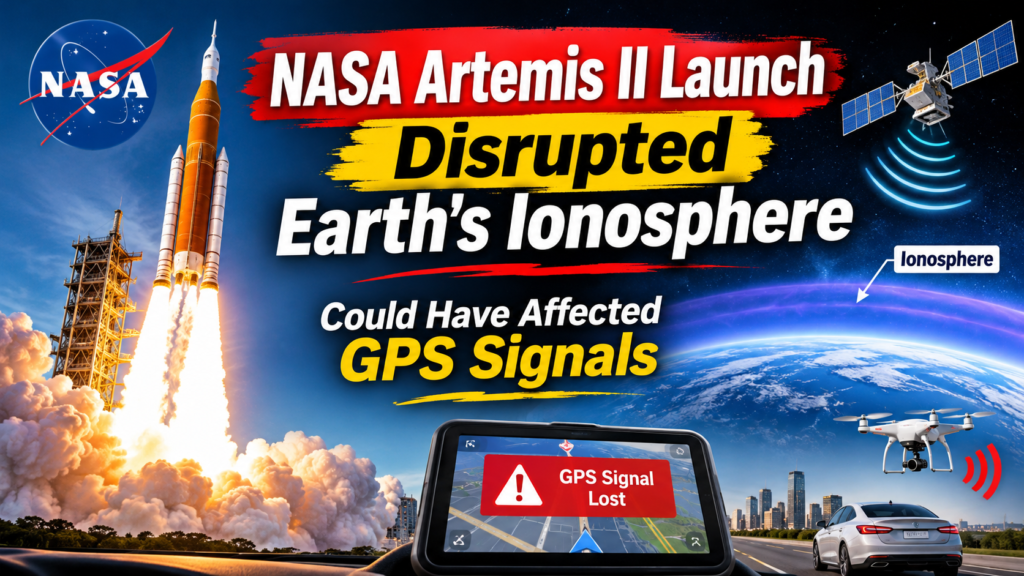
NASA’s Artemis II Moon launch in April 2026 did more than send four astronauts on a historic journey around the Moon. It also created enormous disturbances in Earth’s upper atmosphere that may have temporarily affected GPS accuracy across parts of the United States. A new study found that the rocket’s powerful flight and subsequent engine burns created two major disturbances in the ionosphere. These changes were equivalent to GPS positioning errors of several meters.
That might sound like a small technical issue. However, even a few meters can make a difference when technology depends on precise positioning. Self driving cars could receive inaccurate location information. Drones might struggle to maintain their intended flight paths. Other navigation systems could also experience temporary inaccuracies.
Researchers from Taiwan’s National Cheng Kung University investigated the phenomenon using measurements collected by ground based GPS receivers. Their findings suggest that the effects of powerful rocket launches on Earth’s atmosphere deserve more attention as humanity prepares for more frequent missions to the Moon and Mars.
So how did a rocket traveling into space affect GPS signals on Earth? And should we be concerned about the future of satellite navigation? Let’s look at what happened.
What Happened During NASA’s Artemis II Launch?
NASA launched its Artemis II mission on April 1, 2026 from Kennedy Space Center in Florida. The Space Launch System (SLS) rocket carried four astronauts aboard the Orion spacecraft for a journey around the Moon.
The mission marked the return of astronauts to the lunar environment for the first time in more than 50 years. It also represented an important step toward NASA’s plans for future crewed lunar landings.
However scientists later discovered another remarkable event associated with the launch.
The SLS rocket disturbed Earth’s ionosphere as it traveled through the atmosphere. Researchers identified two enormous atmospheric disturbances stretching approximately 3,100 miles (5,000 kilometers) across the United States.
These disturbances changed the concentration of free electrons in the upper atmosphere. Since GPS signals must travel through this atmospheric layer before reaching receivers on Earth those changes could affect the accuracy of positioning measurements.
In simple terms the rocket’s journey temporarily changed the conditions through which satellite navigation signals traveled.
How Did the Artemis II Rocket Create Holes in Earth’s Atmosphere?
To understand the discovery we first need to understand what happens when a powerful rocket travels through Earth’s atmosphere.
A rocket such as NASA’s SLS does not simply move upward like an ordinary aircraft. It accelerates at enormous speeds and produces powerful shock waves as it travels through different atmospheric layers.
These shock waves can disturb the surrounding air and create changes in atmospheric density.
Scientists call some of these effects traveling ionospheric disturbances. Rocket exhaust can also reduce the concentration of free electrons in particular regions of the ionosphere.
The result can look like a hole or depleted area in the electrically charged upper atmosphere.
Two Major Disturbances Followed the Artemis II Launch
Researchers identified two separate disturbances associated with the Artemis II mission.
- The SLS core stage created the first disturbance
The first disturbance followed the passage of the rocket’s 212 foot long (65-meter) core stage.
As the powerful rocket traveled through the atmosphere its movement generated shock waves that disturbed the surrounding atmospheric conditions.
- The upper stage created another disturbance
The second disturbance followed two engine burns by the rocket’s upper stage.
These burns occurred approximately 115 miles (185 kilometers) above Earth. They helped propel the Orion spacecraft away from Earth and onto its journey toward the Moon.
Interestingly researchers found that the disturbances associated with these upper stage burns were even more prominent than those connected to the rocket’s initial ascent.
Both disturbances extended across thousands of miles. Their scale demonstrated how a single rocket launch could produce atmospheric effects over a surprisingly large region.
Why Does the Ionosphere Matter for GPS Signals?
The ionosphere is an electrically charged region of Earth’s atmosphere. It begins roughly 50 kilometers (30 miles) above the planet and extends much farther into space.
It contains free electrons and charged particles that interact with radio signals traveling from satellites toward Earth.
This matters because GPS technology relies on accurately measuring the time satellite signals take to reach a receiver.
GPS receivers calculate their position by measuring distances to multiple satellites. In general a receiver needs signals from at least four satellites to determine its three dimensional position and correct its clock.
However satellite signals do not travel through empty space all the way to our phones or navigation devices.
They must pass through Earth’s ionosphere first.
When the concentration of free electrons changes the speed at which radio signals travel through the ionosphere can also change. This affects the signal’s travel time and can introduce errors into distance calculations.
Even a small timing difference can translate into a noticeable positioning error.
How GPS Errors Can Affect Everyday Technology
Most of us use GPS without thinking about the science behind it.
We open a navigation app enter a destination and follow the directions. The technology appears simple because satellites and receivers handle complicated calculations in the background.
But accurate positioning becomes particularly important when machines make decisions automatically.
Consider these examples:
- Self-driving cars: An inaccurate position could affect lane identification or navigation decisions. A vehicle operating with several other sensors may compensate but the error could still complicate automated driving.
- Delivery drones: Drones depend on reliable positioning to follow planned routes and reach specific delivery locations. GPS inaccuracies could make navigation more difficult.
- Agricultural equipment: GPS guided tractors and other machinery use precise positioning to follow field patterns and avoid unnecessary overlap.
- Surveying equipment: Professionals use high precision satellite measurements to map land and monitor changes in Earth’s surface.
- Navigation systems: Ships and aircraft also depend on satellite based positioning for important navigation tasks.
The important point is that GPS accuracy is not simply about finding the nearest restaurant or checking directions. Many modern technologies depend on reliable positioning to operate safely and efficiently.
Could Artemis II GPS Disturbances Have Caused Self-Driving Car Problems?
This is one of the most interesting concerns raised by the research.
Charles Lin, an Earth science professor at National Cheng Kung University and a co author of the study explained that positioning errors of a couple of meters could affect decisions made by autonomous vehicles.
A self driving car needs to understand exactly where it is on the road. It must distinguish between individual lanes and recognize nearby vehicles and obstacles.
Imagine a car traveling along a busy highway. Its navigation system identifies the vehicle as being in one lane when it is actually closer to another.
A positioning error could complicate lane selection or route planning.
However we should not assume that every GPS disturbance would immediately cause an accident.
Modern autonomous vehicles use multiple technologies to understand their surroundings. These can include cameras, radar, lidar and onboard sensors. Such systems can help compensate for inaccurate satellite positioning.
The same applies to drones. Their navigation systems may use additional sensors and positioning methods to maintain stability.
The study highlights a potential risk rather than documenting confirmed accidents or widespread failures caused by Artemis II.
That distinction matters. Researchers identified atmospheric changes equivalent to positioning errors of several meters. They did not establish that self driving cars or drones actually crashed because of the launch.
How Powerful Was Artemis II Compared With SpaceX Starship?
Another striking finding concerns the strength of the atmospheric disturbances.
According to the researchers the ionospheric effects associated with Artemis II were more intense than those observed during other rocket launches examined in their comparisons.
Some of the disturbances were up to ten times more intense than those recorded after SpaceX Starship test launches.
This comparison is particularly interesting because Starship produces approximately twice the liftoff thrust of NASA’s SLS.
So why did Artemis II produce such significant effects?
The answer is not necessarily the rocket’s initial thrust alone.
The researchers highlighted the importance of the upper stage engine burns that occurred directly within the ionosphere. These burns created disturbances at much higher altitudes than the initial launch.
This suggests that scientists need to consider what happens throughout a rocket’s journey rather than focusing only on the power generated at liftoff.
As future missions travel beyond Earth orbit their engine operations could create atmospheric effects that deserve closer investigation.
How Did Scientists Discover the GPS Disturbances?
The research team used measurements from high precision ground-based GPS receiver networks.
These receivers are operated by scientific institutions and are commonly used to monitor tiny movements of Earth’s surface.
For example researchers use GPS measurements to track tectonic plate movements and study geological activity that may help scientists understand earthquake risks.
The same equipment can also provide valuable information about Earth’s atmosphere.
Scientists examined how long satellite signals took to travel from GPS satellites to receivers on the ground.
By comparing those measurements they could estimate changes in the ionosphere’s total electron content.
This allowed the researchers to reconstruct the atmospheric disturbances associated with the Artemis II launch.
The approach is particularly useful because it turns an existing scientific monitoring network into a tool for studying space weather and rocket related atmospheric effects.
Their findings were reported in a research preprint associated with Geophysical Research Letters.
Are Rocket Launches More Dangerous to GPS Than Solar Storms?
Not necessarily. Solar storms can create much larger and longer lasting disruptions to satellite navigation.
The Sun regularly releases charged particles and bursts of energy into space. When these particles interact with Earth’s magnetic field and atmosphere they can disturb the ionosphere.
During severe solar storms these disturbances can interfere with GPS accuracy and other radio communication systems.
In some cases the effects can continue for days.
Rocket related disturbances are generally much shorter lived.
The Artemis II findings are still important because they show that human activities can also influence the atmospheric conditions that satellite signals pass through.
Here is a simple comparison:
| Feature | Rocket launch disturbances | Solar storm disturbances |
| Main cause | Rocket shock waves and engine activity | Charged particles from the Sun |
| Atmospheric effect | Localized changes in electron density | Large-scale ionospheric disturbances |
| GPS impact | Temporary positioning inaccuracies | Potentially significant navigation errors |
| Duration | Generally shorter-lived | Can last for days |
| Coverage | Can extend across large regions | Can affect extensive geographical areas |
Both phenomena deserve scientific attention because reliable satellite navigation has become essential to modern infrastructure.
What Does This Discovery Mean for Future Moon and Mars Missions?
NASA’s Artemis program is designed to support a renewed human presence on the Moon and prepare for more ambitious space exploration.
Artemis II was an important milestone because it tested systems needed for future crewed missions.
But the GPS findings introduce another question: How will increasing rocket activity affect Earth’s atmosphere?
As more space agencies and private companies develop powerful launch vehicles scientists may need to monitor atmospheric disturbances more closely.
Future missions could involve:
- More frequent launches of heavy lift rockets.
- Multiple engine burns at high atmospheric altitudes.
- Increased commercial satellite deployment.
- Crewed missions to the Moon and eventually Mars.
- More complex launch schedules involving different space agencies.
Understanding these effects could help scientists improve GPS correction models and develop better ways to predict atmospheric disturbances.
It could also help engineers design navigation systems that remain reliable when satellite signals encounter unusual atmospheric conditions.
The findings do not mean that rocket launches should stop. Instead they show why space exploration and atmospheric research need to develop together.
Frequently Asked Questions
Did NASA’s Artemis II launch really create holes in Earth’s atmosphere?
Yes. Researchers identified two major ionospheric disturbances associated with the Artemis II rocket’s core stage and upper stage engine burns. These disturbances involved changes in electron density across large areas of the atmosphere.
Did the Artemis II launch disrupt GPS signals?
The research found atmospheric changes equivalent to GPS positioning errors of several meters. However the study does not establish that widespread GPS failures or real world navigation accidents occurred.
Can rocket launches affect self-driving cars?
Potential changes in ionospheric conditions can affect GPS positioning accuracy. Since autonomous vehicles use location information for navigation, inaccurate readings could complicate certain driving decisions. However modern vehicles also rely on other sensors to reduce these risks.
Why does the ionosphere affect GPS accuracy?
GPS signals travel through the ionosphere before reaching receivers on Earth. Changes in the concentration of free electrons can affect signal travel time and introduce errors into the distance calculations used to determine location.
Will future Moon missions create similar atmospheric disturbances?
They could. Powerful rockets and upper-stage engine burns can produce ionospheric disturbances. As lunar and planetary missions become more frequent, scientists will need to study these effects and improve ways to monitor and predict them.
Conclusion: Artemis II Revealed an Unexpected Effect of Space Exploration
NASA’s Artemis II mission was a historic achievement for human space exploration. It brought astronauts back to the lunar environment and moved NASA closer to its long term ambitions for the Moon and beyond.
However its effects were not limited to space.
The research from National Cheng Kung University revealed that powerful rocket launches can disturb Earth’s ionosphere on a massive scale. These changes can affect how GPS signals travel through the atmosphere and potentially introduce positioning errors of several meters.
For everyday users, the effects may seem distant. But for autonomous vehicles, drones, aircraft and other technologies that depend on accurate satellite navigation even small errors deserve attention.
We should not mistake these findings for proof that Artemis II caused widespread GPS failures. Instead they offer an important reminder that space exploration can have unexpected effects on systems we depend on here on Earth.
As humanity prepares for more ambitious journeys to the Moon and Mars understanding these atmospheric changes will become increasingly important.
For more informative stories about science, technology, space exploration and developments shaping our world keep following The FAB ATTIRE for further reading and useful insights.
